Simulation & modeling engineer for satellite and wireless communication systems, and PhD computational astrophysicist

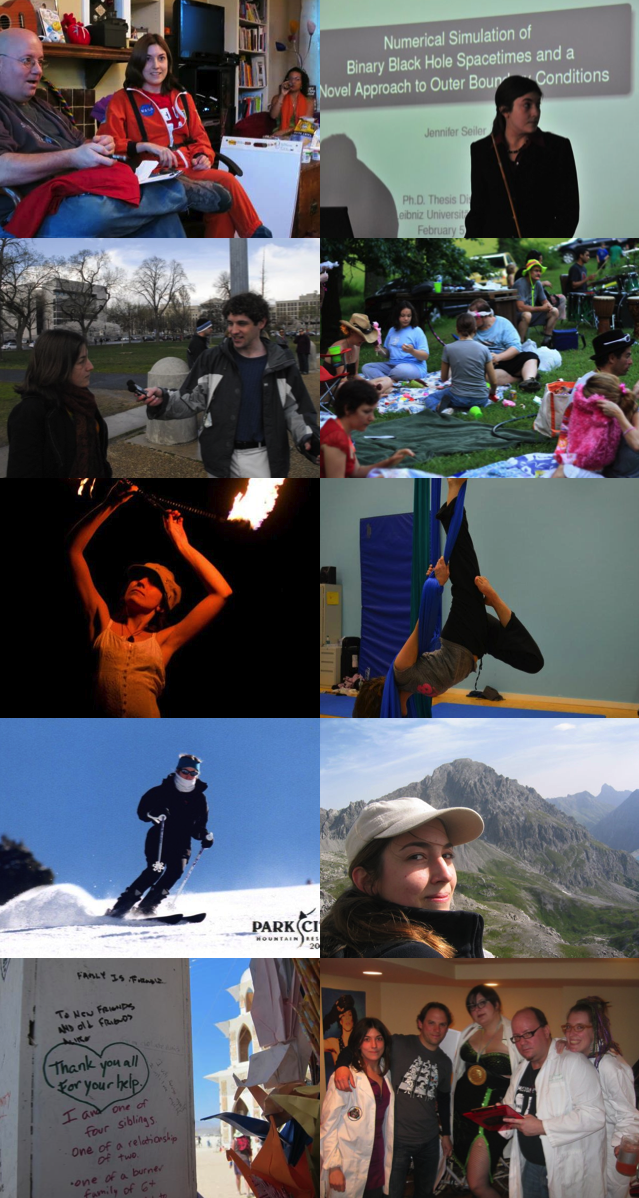
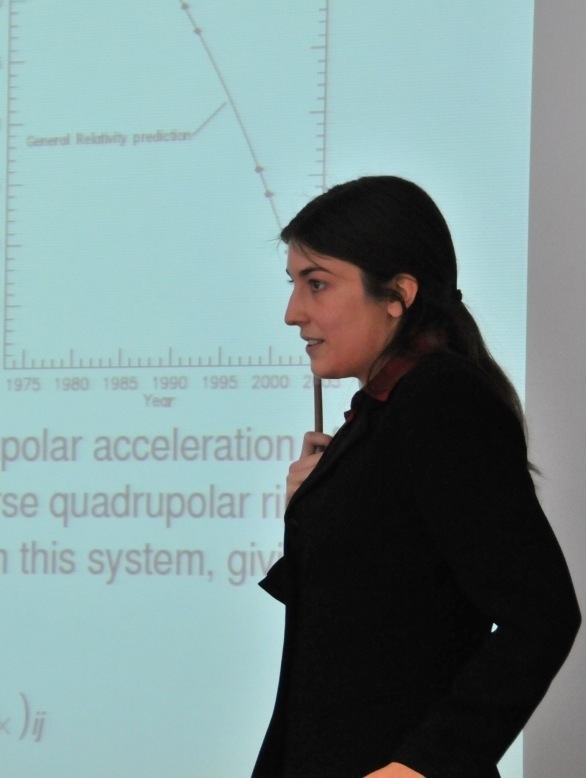
Jennifer Seiler presenting research

Introduction

I am a computational physicist, and software and simulation engineer with 20+ years of experience in modeling, simulation, scientific software development, and technical analysis. I have also worked in developing and promoting reproducible research and analysis methods, and maintainable shared code.

Since 2020 I have focused on wireless communications and spectrum-sharing studies at Auria Space (formerly RKF Engineering LLC), where I work as Senior Engineer (Regulatory). I develop simulation tools and analyses for regulatory, advocacy, and system-engineering work involving optimization, propagation, coexistence, and long-range communications. My work covers interference, compatibility, and coexistence studies across multiple frequency bands and services (including Wi-Fi, IMT, satellite, and fixed-service impacts), and Article 22 / EPFD compliance assessments for satellite operators. I support regulatory activities by analyzing technical studies, contributing to spectrum-related assessments, and participating in ITU-R and related groups (including WP 4A, WP 5C, WP 5D, and ECC). I work regularly in SEAMCAT, STK, Visualyse Professional, and the ITU BR software tools, and where a study has needed capability those tools did not cover, I have written my own implementations of the underlying ITU-R methodologies — including S.1503 for NGSO PFD masks and Article 22 licensing, and M.2101 for terrain-driven IMT interference modeling.

Prior to that, for five years, I worked for Giant Army as Staff Astrophysicist and Developer on Universe Sandbox, a physics simulator sandbox game available on Steam. The game has n-body gravity simulation, climate and materials simulation, stellar evolution and much more. I worked on the grid based EBM and GCM climate modeling, hydrodynamics, collision physics, Roche fragmentation, and stellar evolution simulation codes.

Before that, I worked for the Department of Statistics at Columbia University studying open coding, open data, big data management, and statistical issues of reproducibility in the sciences. A major focus was a project called ResearchCompendia.science, a web service that allows researchers to run codes associated with scientific publications, and allows authors of publications to create companion websites on which others may reproduce the paper's results or run their own parameters.

Prior to that, I worked in the field of numerical relativity. I have ten years of experience designing, developing and testing massively parallel numerical simulations that evolve highly non-linear partial differential equations (the Einstein Equations) in three or more dimensions for dynamical systems (close binary black holes and neutron stars). Though my degrees are in physics and astrophysics, I have a strong and unique computer science background in software development and testing, numerical simulations, analysis, database management, and cluster management.

My main operating system is Linux (though I use macOS since NASA). I have extensive experience with both independent and large scale collaborative software design, development, and testing. I have experience developing for parallelized simulation software (Cactus and Carpet), distributed computing software (Einstein@Home), game development in C# and Unity (Universe Sandbox), and visualization software (DUSTVis). I have extensive experience with versioning systems (Git, SVN, CVS), and database management.

My personal simulation codes are usually C++ (parallelized with OpenMP or MPICH). Smaller simulations are written in Python or Java. Collaborative simulation codes are sometimes Fortran. For analysis I use Python, R, Gnuplot, Octave, MATLAB, Mathematica, or Maple. Scripting for simulation management and analysis is usually Python, Ruby, bash, or Perl. I am always quick and eager to learn new languages and tools.

From 2010 to late 2012 I occupied a NASA Postdoctoral Position (NPP) in the Astrophysical Sciences Division at NASA Goddard Space Flight Center doing numerical relativity and gravitational astrophysics related to the LISA mission (Laser Interferometer Space Antenna) and relevant to LIGO (Laser Interferometer Gravitational-Wave Observatory).

I received my Ph.D. from the Leibniz University of Hannover, Germany for research at the Max-Planck Institut für Gravitationsphysik (Albert Einstein Institute) in February 2010 for the thesis "Numerical Simulation of Binary Black Hole Spacetimes and a Novel Approach to Outer Boundary Conditions."

I am currently living in Washington, DC. In my free time I occupy myself with open source projects, online coursework, electrical engineering projects, interactive public art, fire spinning, and rock climbing.

I like hunting dragons, I like rapid prototyping, and I get compulsively excited about results on the horizon. I am never bored. I am passionate and hard working, but I also enjoy life and am very engaged — I don't believe those two things need to clash.
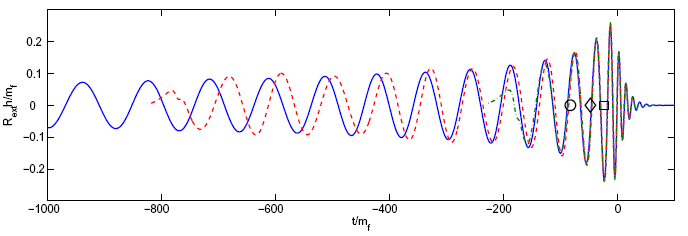
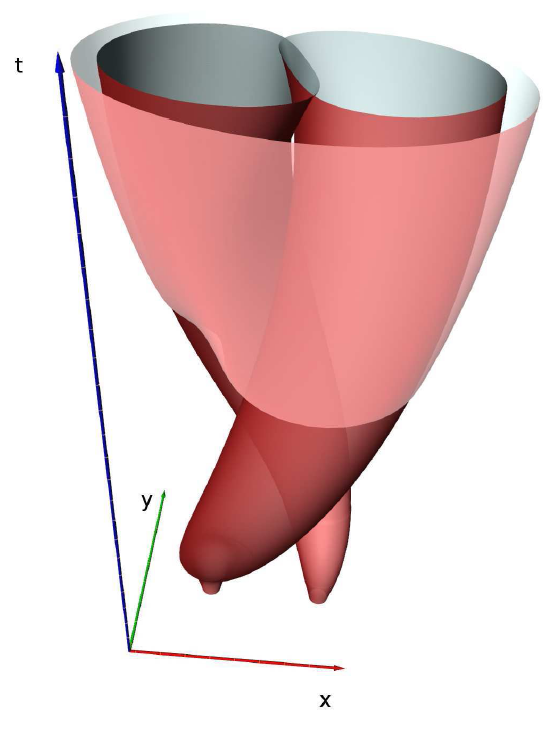
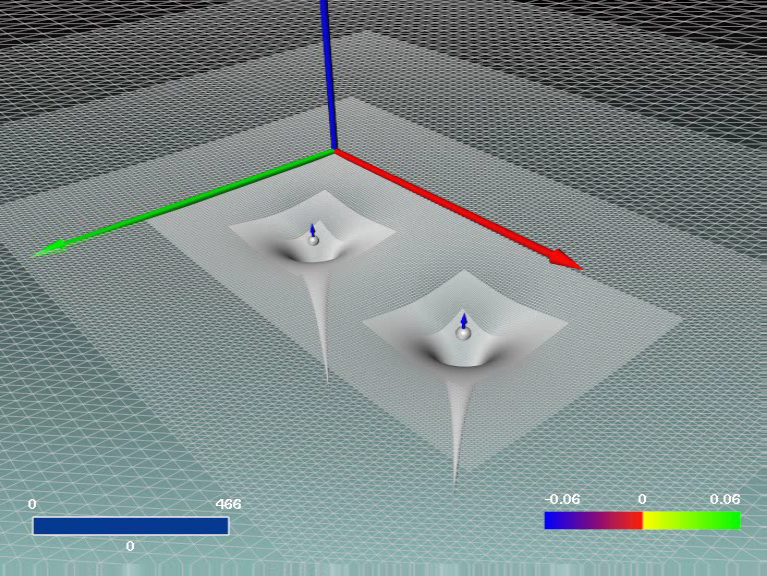
Map of collaborator locations NASA Goddard supercomputing cluster Waveform matching plot Harmonic evolution spacetime diagram

Professional Experience

Senior Engineer (Regulatory)

Auria Space (formerly RKF Engineering LLC) · Bethesda, MD

I work as a simulation and modeling engineer for wireless communications solutions, developing software, simulations, and technical analyses for wireless communications, spectrum-sharing, and regulatory advocacy studies involving satellite, terrestrial, and unlicensed systems. I perform interference, compatibility, and coexistence studies across multiple frequency bands and services (including Wi-Fi, IMT, satellite, and fixed-service impacts), and Article 22 / EPFD compliance assessments for satellite operators. I support regulatory activities by analyzing technical studies, contributing to spectrum-related assessments, and participating in ITU-R and related groups (including WP 4A, WP 5C, WP 5D, and ECC). I build and apply custom simulation and analysis tools in C++, Python, and related environments for network behavior, propagation, long-range skywave/HF communications analysis, resource optimization, and large-scale satellite and terrestrial system studies.

I work across the standard toolset for this field — SEAMCAT for Monte Carlo Fixed-Service compatibility studies supporting CEPT, STK for NGSO constellation work for satellite operator clients, and Visualyse Professional and the ITU BR software suite for PFD masks and Article 22 compliance. I have also written my own implementations of ITU-R S.1503 for NGSO licensing and of ITU-R M.2101 for modeling IMT interference into victim systems using SRTM terrain data.

Astrophysicist and Developer

Giant Army · Seattle, WA (remote)

I worked as a Developer and the Staff Astrophysicist improving the physics, planetary science, climate simulation, and stellar astronomy of Universe Sandbox. The game is a physics-based space simulator that allows users to simulate galaxies, planetary systems, climates, collisions, structure formation, Roche fragmentation, stellar evolution, material phases, fluid dynamics, and much more.

Postdoctoral Research Scientist

Columbia University · New York, NY (remote)

Postdoctoral position in the Department of Statistics researching issues of reproducibility in science. A major focus was ResearchCompendia.science, a web service that allows researchers to run codes associated with scientific publications. The service allows authors of publications to create companion websites on which others may reproduce the paper's results or run their own parameters on virtual machines on AWS servers. It is entirely open source.

NASA Postdoctoral Position

NASA Goddard Space Flight Center · Goddard, MD

Extended postdoctoral position in the numerical relativity group in the Astrophysical Sciences Division for the LISA (Laser Interferometer Space Antenna) project. Numerical simulation of binary black hole spacetimes, electromagnetic counterparts to black hole interactions, and matter fields around binary black hole systems. I developed original code for the large scale simulations, data management, and both on-the-fly and post-processing data analysis of the precession of spins in binary systems. I also contributed to the Einstein Toolkit, an open source modular physics simulation project for adaptive mesh simulations.

PhD Research Scholar

Max-Planck Institut für Gravitationsphysik · Potsdam, Germany

PhD work on numerical simulations of black hole spacetimes. My focus was on well-posed constraint preserving boundary conditions, with additional work on constraint damping methods, gravitational wave detectability, and phenomenological waveforms and predictions for binary final spin and kick. I wrote original code for all of these tasks and ran a gamut of large simulations to cover the parameter space, managed by my own job-running and data-management scripts.

Visiting Scientist

Albert Einstein Institute · Potsdam, Germany

Visiting scientist in Potsdam, Germany. I wrote a parallelized numerical code to generate initial data and evolve a simulation of the propagation of gravitational waves off a potential in a three dimensional coordinate system and track constraint propagation and violation.

Undergraduate Researcher

Cornell University · Ithaca, NY

Worked for Prof. Saul Teukolsky on software for the visualization and analysis of numerical simulations of solutions to the Einstein equations, including inspiraling neutron star and black hole systems, binary black holes, and accretion disks. Called DUSTVis, it is an OpenDX visualization program designed to be used with the Caltech/Cornell DUST algorithm.

Undergraduate Researcher

Cornell University · Ithaca, NY

Designed software for an industrial chemical waste exchange program, titled the National Trash to Treasure Network, for submission to the EPA as a project offering voluntary participation to companies as an alternative to fines. A company can list its waste chemicals or search for chemicals it needs; a learning algorithm finds other chemicals with similar properties for the buyer and evaluates the cost of transportation and processing.

Internship for Physics Majors

Fermi National Accelerator Lab · Batavia, IL

Participated in the Internship for Physics Majors Program (IPM). I designed and programmed the track-finding algorithm for the Level 1 Trigger Code for the BTeV project — finding detached tracks that signify an exotic decay, on-the-fly in the detector firmware, to determine which of the terabytes of incoming data to store and which to dump. I decreased false positives 17%.

Internship

Naval Research Laboratories · Washington, DC

Worked in the Electronics Science & Technology Division on the optimization of natural growth of Silicon dioxide, SiGe, and SiC samples via Molecular Beam Epitaxy. Experimented with temperature and surface segregation dependencies of Phosphorous doping rates via Molecular Beam Epitaxy.

Internship

Michigan State University · East Lansing, MI

Worked in the National Superconducting Cyclotron at Michigan State University. I wrote data analysis code in C++ and analyzed data collected from Gold-on-Gold collisions at energies from 20–60 AMeV for a better understanding of flow through stellar core collapses.

Table of Contents

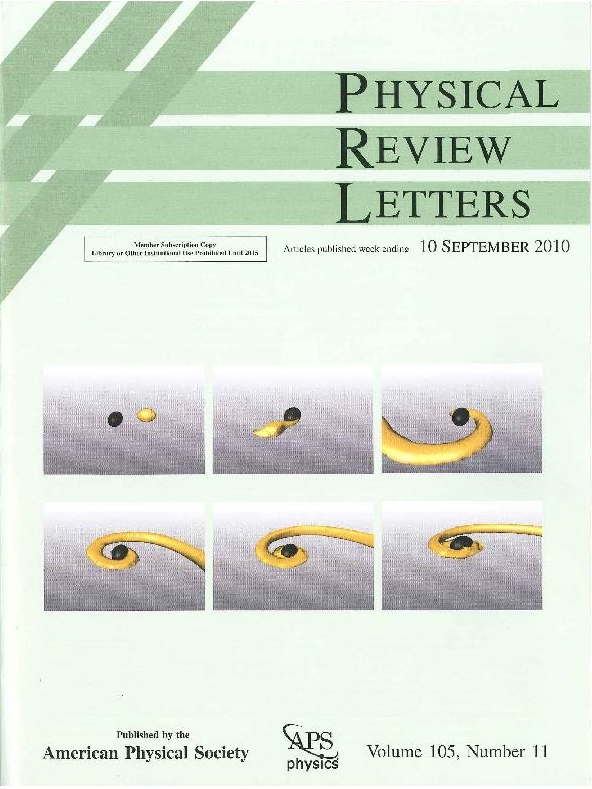
Astrophysical Journal cover Physical Review Letters cover Classical and Quantum Gravity cover Physical Review D cover

Publications

  • J. Seiler. Numerical Simulation of Black Hole Spacetimes and a Novel Approach to Outer Boundary Conditions. Leibniz Universität Hannover Physics Library. Link: THESIS
  • L. Rezzolla, P. Diener, E. N. Dorband, D. Pollney, C. Reisswig, E. Schnetter, J. Seiler. The Final Spin From the Coalescence of Aligned-spin Black-hole Binaries. Astrophysical Journal 674 (2008) L29. Preprint: arXiv.org:0710.3345 [gr-qc]
  • L. Rezzolla, E. Barausse, E.N. Dorband, D. Pollney, C. Reisswig, J. Seiler and S. Husa. On the final spin from the coalescence of two black holes. Physical Review D 78 (2008) 044002. Preprint: arXiv:0712.3541 [gr-qc]
  • J. Seiler, B. Szilagyi, D. Pollney. Constraint Preserving Boundaries for a Generalized Harmonic Evolution Systems. Classical and Quantum Gravity 25 (2008) 175020. Preprint: arXiv:0802.3341 [gr-qc]
  • B. Aylott, et al. (including J. Seiler). Testing gravitational-wave searches with numerical relativity waveforms: Results from the first Numerical INJection Analysis (NINJA) project. Classical Quantum Gravity 26 (2009) 165008. Preprint: arXiv:0901.4399 [gr-qc]
  • B. Aylott, et al. (including J. Seiler). Status of NINJA: the Numerical INJection Analysis project. Classical Quantum Gravity 26 (2009) 114008. Preprint: arXiv:0905.4227 [gr-qc]
  • C. Reisswig, S. Husa, L. Rezzolla, E. Dorband, D. Pollney and J. Seiler. Gravitational-wave detectability of equal-mass black-hole binaries with aligned spins. Physical Review D 80 (2009) 124026. Preprint: arXiv:0907.0462 [gr-qc]
  • L. Santamaria, F. Ohme, P. Ajith, B. Bruegmann, N. Dorband, M. Hannam, S. Husa, P. Moesta, D. Pollney, C. Reisswig, E. L. Robinson, J. Seiler, B. Krishnan. Matching post-Newtonian and numerical relativity waveforms: systematic errors and a new phenomenological model for non-precessing black hole binaries. Physical Review D 82 (2010) 064016. Preprint: arXiv:1005.3306 [gr-qc]
  • P. Ajith, M. Hannam, S. Husa, Y. Chen, B. Bruegmann, N. Dorband, D. Muller, F. Ohme, D. Pollney, C. Reisswig, L. Santamaria, J. Seiler. “Complete” gravitational-waveforms for black-hole binaries with non-precessing spins. Phys. Rev. Lett. 106 (2011) 241101. Preprint: arXiv:0909.2867 [gr-qc]
  • V. Stodden, S. Miguez, J. Seiler. ResearchCompendia.org: Cyberinfrastructure for Reproducibility and Collaboration in Computational Science. IEEE Computing in Science & Engineering 17(1) (2015) 12–19. Link: Scientific Software Communities
  • V. Stodden, J. Seiler, Z. Ma. An empirical analysis of journal policy effectiveness for computational reproducibility. Proceedings of the National Academy of Sciences 115.11 (2018): 2584–2589. Link: 10.1073/pnas.1708290115

Manuscripts

  • J. Seiler, J. Baker, B. Kelly. Precession Mapping of Black Hole Binaries via Minimization of Asymmetric Harmonic Modes of Gravitational Waves. [in preparation]
  • J. Seiler, D. Pollney, B. Wardell, D. Nunez. Constraint Preserving Boundary Conditions for BSSN in the Linearized Regime.
  • J. Seiler, S. Husa, J. Baker. Numerical Simulation of Black Hole Binaries with ‘Trumpet’ Initial Data.

Table of Contents

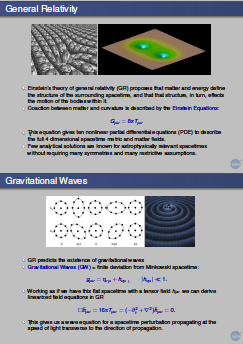
Talk title slide collage

Contributed Talks

Workshops and Conferences

  • PyCon 2014
    Montreal, Quebec, Canada — April 11–13, 2014
  • Scientific Software Days 2013
    Austin, TX, USA — December 16–17, 2013
  • 19th International Conference on General Relativity and Gravitation (GRG19)
    Mexico City, Mexico — July 5–10, 2010
  • Numerical Relativity and Data Analysis/CAPRA Meeting (NRDA/CAPRA 2010)
    Waterloo, Canada — June 20–26, 2010
  • Numerical Relativity and Data Analysis Meeting (NRDA 2009)
    Golm, Germany — July 6–9, 2009
  • XXXI Spanish Relativity Meeting (E.R.E. 2008)
    Salamanca, Spain — September 15–19, 2008
  • Numerical Relativity and Data Analysis Meeting (NRDA 2008)
    Syracuse, NY — August 11–14, 2008
  • Frontiers in Numerical Gravitational Astrophysics (J.A. Wheeler School)
    Erice, Italy — June 27–July 5, 2008
  • Post Newton 2008 International Workshop
    Jena, Germany — June 11–14, 2008
  • XXX Spanish Relativity Meeting (E.R.E. 2007)
    Puerto de la Cruz, Tenerife, Spain — September 10–14, 2007
  • 18th International Conference on General Relativity and Gravitation (GRG18)
    Sydney, Australia — July 8–14, 2007
  • AEI Performance Improvement Workshop
    Albert-Einstein-Institut, Potsdam, Germany — December 4–15, 2006
  • From Geometry to Numerics Workshop
    Institut Henry Poincaré, Paris, France — November 20–24, 2006
  • XXIX Spanish Relativity Meeting (E.R.E. 2006)
    Palma de Mallorca, Spain — September 4–8, 2006
  • New Frontiers in Numerical Relativity Conference
    Albert-Einstein-Institut, Potsdam, Germany — July 17–21, 2006
  • 3rd High-End Visualization Workshop
    University of Innsbruck, Obergurgl, Austria — April 25–28, 2006
  • 2005 Oberjoch Seminars
    University of Tübingen, Oberjoch, Germany — October 10–14, 2005
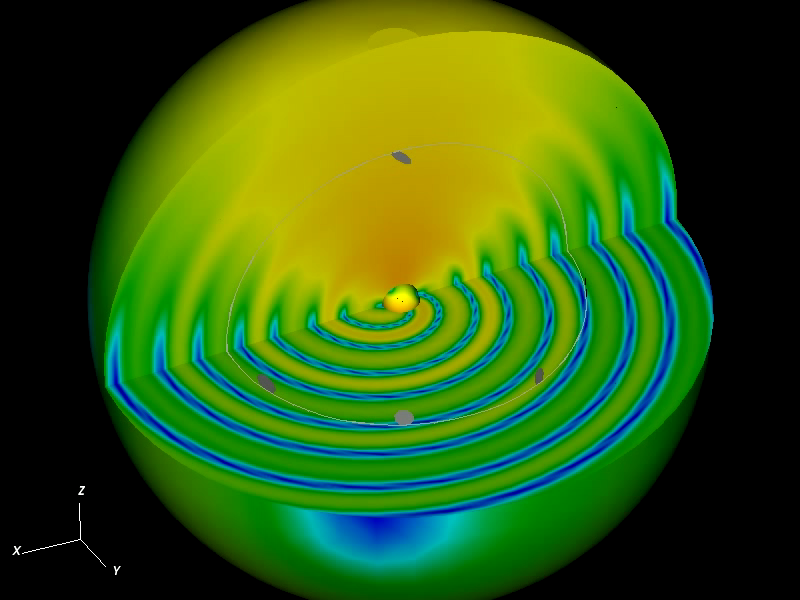
Signal-to-noise ratio surface plot Three-dimensional surface plot with contour projections Simulation render of radiating wavefronts Simulation source code over a rendered simulation output

Skills and Abilities

RF Models and Tools

Interference, sharing & coordination

  • Visualyse Professional
  • STK
  • SEAMCAT
  • ITU BR software (SpaceCap, SpaceVal, SpaceQry, GIMS, GIBC)

Working party experience

  • ITU-R WP 4A
  • WP 4C
  • WP 5D
  • WP 7B/C/D
  • CEPT/ECC

ITU-R methods implemented

  • ITU-R S.1503
  • ITU-R M.2101
  • ITU-R P.452
  • ITU-R P.2108/P.2109
  • ITU-R P.618
  • ITU-R P.676
  • ITU-R S.1528
  • ITU-R F.1336
  • EPFD / PFD masks
  • Article 22 compliance
  • NGSO licensing

Propagation

  • TIREM
  • ITM (Longley-Rice)
  • WinProp
  • GRWAVE
  • Proplab-Pro
  • Spectrum XXI

HF / skywave propagation

  • VOACAP
  • ICEPAC
  • IONCAP
  • REC533
  • ITURHFProp
  • CCIR/URSI/IRI climatologies
  • Spectrum XXI

Network & system simulation

  • ns-3
  • 5G-LENA
  • SEM (ns-3)
  • ns-3 mmWave module
  • OMNeT++
  • SNS3

Terrain & geospatial

  • SRTM
  • GDAL
  • KML
  • QGIS
  • GeoPandas

Programming & Web

Languages

  • C/C++/C#
  • Python
  • Java
  • Perl
  • Fortran
  • Ruby
  • Basic
  • PHP
  • JavaScript
  • HTML5/CSS
  • SQL
  • XML
  • APIs
  • MATLAB
  • LaTeX

Version control & DevOps pipeline

  • Git
  • Subversion
  • CVS
  • Docker
  • Celery
  • Heroku
  • Travis CI
  • GitLab CI/CD

Data/ML/Python Stack

Libraries & frameworks

  • NumPy/SciPy
  • pandas
  • Matplotlib
  • Jupyter
  • h5py
  • pycraf
  • itur
  • sgp4
  • Astropy
  • TensorFlow
  • PyTorch
  • Sionna
  • pytest
  • Django

Scientific & visualization software

  • Unity
  • OpenDX
  • Arduino
  • VisIt
  • Mathematica
  • AutoCAD
  • 3ds Max
  • Maxima

Math & Physics Domains

  • Computational/numerical physics
  • General Relativity
  • Electromagnetism
  • Plasma physics
  • Optics
  • Acoustics
  • Orbital mechanics
  • Statistical analysis
  • Optimization
  • PDEs
  • Differential geometry
  • Discrete mathematics

HPC, Cluster & Cloud

  • PBS
  • Scali
  • OpenMPI
  • MPICH
  • Cactus
  • Lustre
  • Hadoop
  • AWS

Operating systems

  • Linux (preferred)
  • macOS
  • Unix
  • Windows
  • DOS

Project & Dev Tools

Agile (SAFe)

  • Azure DevOps
  • Jira
  • ZenHub
  • Jama

Scrum/Kanban

  • Trello
  • OneNote
  • WeKan
  • Keep

IDEs, Editors & Other Tools

  • Visual Studio
  • VS Code
  • emacs
  • vi
  • Xcode
  • Spyder
  • Eclipse
  • Photoshop
  • Ableton
  • Apache

Table of Contents

Cornell University seal Max Planck Society Minerva logo Leibniz University Hannover logo

Education

Ph.D. Physics (magna cum laude)

Max Planck Institut für Gravitationsphysik · Potsdam, Germany

Thesis Title: Numerical Simulations of Binary Black Hole Spacetimes and a Novel Approach to Outer Boundaries
Thesis Advisers: Luciano Rezzolla & Bernard Schutz

  • Atoms and Bits volunteer (technology workshops)
  • Journal club organizer, 2005–2007
  • Teleconference technology support, 2006–2008
  • Lectures at Potsdam University

B.A., Honors Physics

Cornell University · Ithaca, NY

Adviser: Saul Teukolsky
Research Emphasis: Computational Physics; Numerical Relativity; Discrete Mathematics

  • Volunteer for Big Brothers Big Sisters, Ithaca, NY
  • Volunteer for Planned Parenthood of the Southern Finger Lakes, 2003–2005
  • Parliamentary Debate (APDA) at Cornell, 2001–2002
  • Treasurer for the Cornell Chapter of Sigma Phi Sigma, Society of Physics Students, 2003–2005
  • Sister in Sigma Chi Delta coed service fraternity since Fall 2002

H.S. Honors A.P.

Hayfield Secondary School · Alexandria, VA

Research Emphasis: Computer Science; Physics; Architecture

  • It's Academic Varsity Team (Patriot District Champions 1999–2000)
  • College level CS (211) through George Mason University
  • Poetry Club
  • Orchestra, 1997–1999

Keywords

numerical relativity; gravitational astrophysics; computational physics; discrete mathematics; high performance computing; massively parallel, highly scalable systems; scientific computing; distributed computing; large scale mathematical modeling; RF & satellite systems simulation; data processing and analysis; rapid prototyping; systems architecture

Table of Contents

Awards

Fellowships and Grants

Awards and Honors

  • James Hartle Award: talk Constraint Preserving Boundaries in 2nd Order Form at GRG18, 2007
  • Recognition from Graduate Women in Science (for Acoustic Thermometry of Sea Water)
  • Award of Recognition: the Society of Women Engineers (Acoustic Thermometry of Sea Water)
  • Award of Recognition of Outstanding Achievement 2001, US Naval Research Laboratory
  • Intel Virginia State Science Talent Search, 2nd place, 2001 (for Longitudinal Flow in Au-Au Collisions)
  • Intel Science Talent Search Semifinalist 2001 (for Longitudinal Flow in Au-Au Collisions)
  • Recognition from Nat. Science Teachers Association, 2000
  • University of Southern California Young Scientist of the Year, 2000
  • CIA Outstanding Young Scientist (for Acoustic Thermometry of Sea Water)
  • Physlink.com Young Scientist of the Year 2000 (for Acoustic Thermometry of Sea Water)
  • Grand Prize, 1999 NOVA Intel Science and Engineering Fair

Accomplishments

Table of Contents

Projects and Accomplishments

Wireless Communications Simulation, Coexistence, and Spectrum-Sharing Studies

Senior Engineer (Regulatory) · Auria Space (formerly RKF Engineering LLC) · 2020–Present

I develop simulation tools, technical software, and analytical studies for wireless communications systems, with emphasis on spectrum sharing, interference, regulatory compliance, and coexistence assessment across satellite, terrestrial, and unlicensed technologies. My work spans custom packet-level and Monte Carlo simulation, propagation modeling, long-range skywave/HF analysis, and network-level simulation and validation using ns-3 and related tools. Alongside commercial and regulator-provided tooling — SEAMCAT, Visualyse Professional, STK, and the ITU BR software suite — I have written my own implementations of the core ITU-R methodologies where a study needed capability the standard tools did not provide.

  • Wrote an independent implementation of ITU-R S.1503 for NGSO system licensing, generating PFD masks and validating EPFD-on-the-ground limits for Article 22 compliance, complementing the ITU BR software tools used for the same assessments.
  • Developed an original implementation of ITU-R M.2101 to model IMT system interference into victim systems, driven by SRTM terrain data for terrain-specific path loss and visibility analysis.
  • Performed Monte Carlo compatibility and sharing studies in SEAMCAT for Fixed-Service work supporting CEPT, and used STK for NGSO constellation modeling on behalf of satellite operator clients.
  • Performed simulation and technical studies supporting 6 GHz sharing and compatibility analyses, including work relevant to RLAN coexistence, AFC-related modeling, and interference assessments.
  • Authored an HF Propagation Tools Trade Study comparing VOACAP, ICEPAC, and REC533 (ITU-R P.533) for long-range skywave prediction, assessing the methods against one another to guide tool selection for HF communications analysis.
  • Built custom analysis and simulation tools for communications-system design and advocacy tasks, including resource-optimization studies for connected-city applications and software to identify optimal frequencies and bands for skywave long-range communications.
  • Used ns-3 for packet-level traffic modeling and validation of wireless network models, including LTE/5G work with 5G-LENA, satellite communications traffic modeling, and dense Wi-Fi scenario analysis with detailed review of interference, power control, scheduling, path loss, and antenna behavior.
  • Produced reproducible technical outputs for engineering and regulatory use, including simulation configurations, metrics extraction, comparative analyses, and software/code workflows suitable for repeatable study execution.

Universe Sandbox

Universe Sandbox pulsar binary render

Universe Sandbox is a physics simulator sandbox game. It has live N-body Newtonian gravity simulation, collision physics, climate simulation, stellar evolution, magnetic fields, terraforming, materials phase tracking, and educational tutorials.

As the astrophysicist and a developer on the team, I developed stellar evolution simulation, magnetic field simulation (including pulsars), life-likelihood simulation, climate simulation for generic planets, volatile tracking (for things such as Jeans escape, solar wind erosion, material drag, and many other incident fluxes and internal sources of mass loss), and much more. There seems to be no end to the features we can add — I'd also like to add post-Newtonian corrections for simulating black holes and neutron stars.

Cactus

The Cactus Computational Toolkit (CCT) is an open source problem solving environment designed for scientists and engineers. Its modular structure enables parallel computation across different architectures and collaborative code development between different groups.

The name Cactus comes from the design of a central core (“flesh”) which connects to application modules (“thorns”). Thorns can implement custom developed applications; other thorns from a standard computational toolkit provide a range of computational capabilities, such as parallel I/O, data distribution, or checkpointing.

The Einstein Toolkit addresses computational relativistic astrophysics, supporting simulations of black holes, neutron stars, and related systems. I helped develop multiple “thorns” for Cactus, including:

  • the AEIHarmonic evolution code for evolving full 3D evolutions of the Einstein Equations
  • two well-posed, constraint preserving boundary conditions thorns for two different coordinate systems
  • Teukolsky Wave initial data thorn
  • multiple visualization thorns
  • many analysis thorns, including horizon mass estimation and spin orientation analysis
  • contributions to adaptive mesh refinement, I/O, overall optimization, and cross-architecture compatibility

Carpet

Carpet simulation movie frame

Carpet is an adaptive mesh refinement and multi-patch driver for the Cactus Framework. Together they form a software framework for solving time-dependent partial differential equations on block-structured grids. Carpet acts as a driver layer providing adaptive mesh refinement, multi-patch capability, as well as parallelisation and efficient I/O.

I contributed to the optimization, IO, memory allocation and parallelisation, and scalability.

DUSTVis

Gravitational wave visualization

In my time at Cornell I helped develop software for the visualization and analysis of numerical simulations of solutions to the Einstein equations, including inspiraling neutron star and black hole systems, binary black holes, and accretion disks. Called DUSTVis, it is an OpenDX visualization program designed to be used with the Caltech/Cornell DUST algorithm for visualizing data from multiple three dimensional grids with multiple coordinate systems. In addition to the coordinate transformation and C++ OpenDX module boxes for visualization, I developed a UI for both the data I/O and the visualization parameters.

Co-Author on Three of the Top Cited GR Papers of 2009

The three were: “Testing gravitational-wave (GW) searches with numerical relativity waveforms: Results from the first Numerical INJection Analysis (NINJA) project”, “On the final spin from the coalescence of two black holes”, and “The Final spin from the coalescence of aligned-spin black-hole binaries”. I entered the field of numerical relativity two years before the first successful binary black hole simulation in 2005. Since then I have been involved in some of the field's major discoveries:

  • Developed a phenomenological formula to predict the final spin, recoil, and orientation of a merged black hole given only initial data from the originating binary system.
  • Worked with data analysts on the LIGO detector in the NINJA project to test how successful our detector pipelines would be at identifying signals matched against the database of our numerical waveforms.
  • Matched post-Newtonian waveforms for binaries with large separations to numerically generated waveforms for close-in binaries, where only numerical simulations can deal with the non-linearity of the system, to produce long and accurate waveforms for GW detection.

PhD Thesis: Numerical Simulation of Black Hole Spacetimes

I received a fellowship from the International Max-Planck Research School to do my PhD at the Max-Planck Institut für Gravitationsphysik (Albert Einstein Institute), which has supercomputer clusters devoted exclusively to relativity and a large scale collaborative “toolkit” for numerical simulation called Cactus, written in C++. With gravitational wave detectors approaching design sensitivity, the need for numerical GW templates for signal recognition by detector pipelines was an urgent problem; given that binary black hole inspirals and mergers are the strongest potential source for GW signals, my research focused on improving numerical simulations and on the generation of GWs both for detector templates and for astrophysics.

I formulated a set of boundary conditions for artificial boundaries for a first order in time and second order in space formulation of the Einstein equations, and showed that these conditions reduce noise, reduce constraint violation, and increase stability for 3D simulations. My boundary conditions are now used in numerical simulations both within and outside the field of numerical relativity.

ResearchCompendia.org: Connecting Publication to Computation

The ResearchCompendia platform is an attempt to use the web to enhance the reproducibility and verifiability — and thus the reliability — of scientific research. We provide the tools to publish the “actual scholarship” by hosting data, code, and methods in a form that is accessible, trackable, and persistent. Some features include:

  • Remote executability of contributed code for a variety of coding languages and frameworks, and enhanced output presentation.
  • DataCite DOI issuing for compendia, and uploaded code and data objects.
  • Customized portals for journals and institutions requiring differential access and tracking.
  • Entirely open source platform written in Django (Python).

We provide tools to share and archive the data, codes, documentation, parameters, and environmental settings linked with published research all in one place, supporting verification and validation by allowing remote execution of shared codes in our cloud resources and visualization of results — heavily automated, and easy to access, to lessen the burden on already overburdened academic researchers in the process of publishing fully reproducible work.

NTTN

I designed software for an industrial chemical waste exchange program, titled the National Trash to Treasure Network (NTTN), for submission to the EPA as a project for voluntary participation offered to companies as an alternative to fines. A company can list its waste chemicals, or search for chemicals it needs. A learning algorithm finds other chemicals with similar properties for the buyer and evaluates the cost of transportation and processing.

Aerial silks performance

Extracurricular Activities

Outreach / Public Speaking

  • Atoms and Bits volunteer (tech workshops)
  • Lectures for: Science Cafe, Knowledge Commons DC, Burner Salon, UMD CP...
  • Science outreach for: Ithaca Science Center, Cornell SPS...
  • Science Fair judging for: Prince Georges County, Columbia Heights...
  • Led Arduino tech workshop, Craft Days
  • Children's Burn (Fire and Swine) setup/performance (non-Newtonian fluids on a speaker and ‘dancing’ ferrofluids)
  • Adult “Science! Party” Science Fair organizer & judge

Athletic

  • Semi-professional fire performance (poi, rope dart, staff, breathing)
  • Volunteer performer for MDA summer camp, 2010–2011
  • Aerial silks (tissu)
  • Indoor and outdoor rock climbing
  • Hiking, skiing, kayaking…

Community Service

  • Mischief DC board of directors
  • Volunteer for Big Brothers Big Sisters
  • Volunteer for Planned Parenthood
  • Curatorial team for 2012 Figment DC
  • Sister in Sigma Chi Delta coed service fraternity since Fall 2002

Contact